





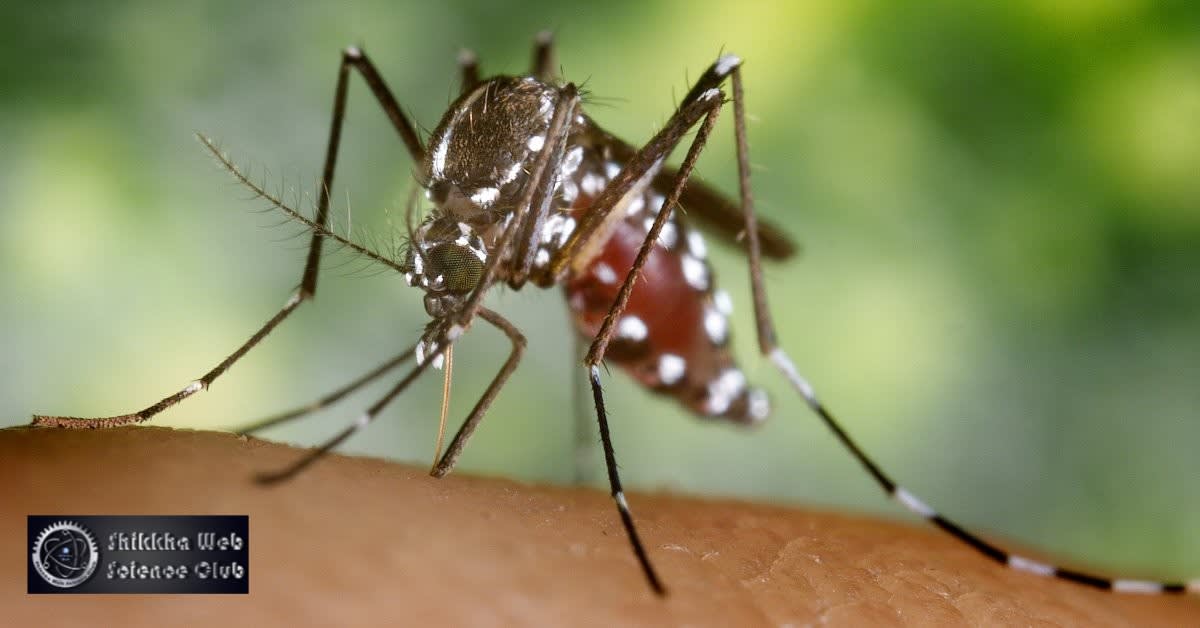
About a year ago chikungunya was something of a trending topic. A record number of people were infected with it. On top of that, a great many people are infected with dengue every year. Awareness is what is needed to stop it.
The mosquito is responsible for both chikungunya and dengue — not every mosquito, but the Aedes mosquito. I put that slightly wrongly. Mosquitoes do not attack anyone; only the female mosquito attacks humans and other animals. And a mosquito cannot bite anyone either: it draws blood from an animal's body with the antenna, or proboscis, on its head. We ought certainly to know how to recognise the dreaded Aedes mosquito, and to know about this carrier of the dengue germ and about the disease itself.
How to recognise the Aedes mosquito
The Aedes mosquito is very easy to recognise with the naked eye. Some of its characteristics:
1. The mosquito's body carries black and white stripes. This is the main way of recognising it. 2. The mosquito's antenna or proboscis looks somewhat hairy. 3. The mosquito is of medium size.
Some important information about the Aedes mosquito has been given by M. M. Aktaruzzaman, manager of the malaria and dengue programme at the Directorate General of Health Services.
How the Aedes mosquito breeds
Where other mosquitoes lay eggs in dirty water to breed, the Aedes mosquito lays eggs only in clean water. The condition, though, is that the water must have been standing for at least a week or thereabouts. That is, this mosquito will not lay eggs in water that has been left for a single day. One more condition is that the water must be stagnant.
When the Aedes mosquito bites
While other mosquitoes bite at any time of day or night, the Aedes mosquito bites only while there is daylight. That is, the Aedes mosquito bites from sunrise to sunset. The rate of biting is highest in the two or three hours after sunrise and in the few hours before sunset. And the Aedes mosquito does not bite at night.
Does a single Aedes bite mean dengue?
Whether one bite from an Aedes mosquito will make you a dengue patient depends on a number of things.
It is not the case that a person will certainly get dengue fever if an Aedes mosquito bites them. If a virus present in the environment infects the Aedes mosquito, then there is a possibility of dengue from that mosquito's bite.
If an Aedes mosquito bites a person while it is carrying the virus, a healthy person can get dengue. And if an Aedes mosquito bites someone suffering from a fever caused by the virus, there is scope for the virus to infect the mosquito.
One thing about the Aedes mosquito is that it usually bites more than one person. So dengue comes from the bite of a mosquito that has picked up the virus from the body of a person suffering a viral fever.
Preventive measures
To stay safe from the Aedes mosquito we have to take some steps ourselves. For example:
1. Clean water must not be left standing anywhere. 2. Take care that water does not collect in flowerpots. 3. Bushes and undergrowth must be kept clear. 4. When Aedes mosquitoes are prevalent, a mosquito net must be used at the start of the day and in the evening. If possible, keep the net up all day. 5. Every part of the house must be kept clean daily, so that mosquitoes do not gather together in the dark. 7. Mosquito repellent or aerosol must be used regularly.
If everyone becomes aware, I hope a great deal of the problem will be solved.