





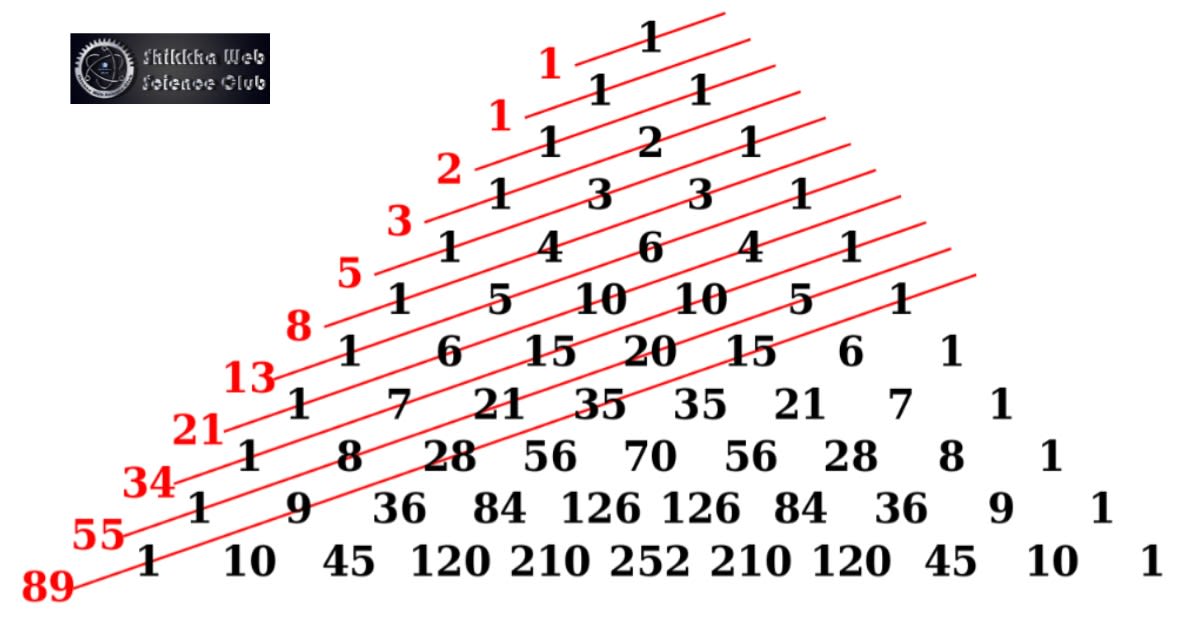
Remember that class eight maths had a chapter called Patterns? There was a series in it called the Fibonacci series (Fibonacci Series). Let me write the series out a little:
1, 1, 2, 3, 5, 8, 13, 21, 34, 55, 89, 144, …..
Yes, the name of this remarkable series is the Fibonacci series. I call it remarkable because nature follows this series. What? Surprised? There is nothing to be surprised about. We will discuss all this. It is said that the Fibonacci series explains the mystery of creation. Before we get to grips with this series, let's take a moment to learn what a series actually is.
Series
One important topic in mathematics is the series. A series means the addition of an infinite or a finite number of quantities. From this we can see that there can be two kinds of series.
1. Finite series 2. Infinite series
Finite series
A series that has a limit. That is, a series that has an end is a finite series. That is exactly what the word finite means. The sum of such a series is easy to find, because it has a limit. Adding up to that limit will be easy so long as you can work out the pattern! An example:
1+6+11+16+21+26+31
Infinite series
A series that has no limit is what we will call an infinite series. Infinite means without limit — something that has no end. So the terms of the series have no end either. There is a problem here. How will you add up all the terms of something whose end you do not even know? But in fact an infinite series can also be added easily. There are certain conditions in that case. Anyway, I will not go that way. Let's look at an example:
1+6+11+16+21+26+31+…..+1121+…..+∞
So much for the idea of a series. Now let's come back to the Fibonacci series.
The Fibonacci series
The famous thirteenth-century mathematician ‘Leonardo of Pisa‘ discovered this series. From his nickname ‘Fibonacci‘ the series takes the name ‘Fibonacci series‘. Here it is again, so you can see it:
1, 1, 2, 3, 5, 8, 13, 21, 34, 55, 89, 144, …..
Notice that the value of each term is the sum of the preceding terms. For instance the 6th term is 8, from the sum of the two preceding terms — the 4th and 5th, 3+5. In the same way the 10th term is 55, from 21+34. The rest follow in the same way.
So we understand the series. But what is it for? What good does this series do?
The Fibonacci series in nature
The mathematician Fibonacci 1203 first noticed this series in the breeding of rabbits. Suppose you have two rabbits. Now they will breed. If breeding starts from two rabbits and not a single rabbit dies, then in 10 months there will be 55 rabbits, after 11 months 89, and after 12 months the number will stand at 144! That is when the pattern came into view.
Now look at the Fibonacci series above once more. What were the 10th, 11th and 12th terms? 55, 89 and 144, weren't they? They match, don't they? Don't be surprised. Remember Shah Rukh Khan's line, “Picture abhi baaki hai mere dost”? Hold that thought, because there are more surprises 😉
So — is it only in rabbits? The answer is “no.” Countless examples are scattered through nature. Let's find out.
1. Birds flying in the sky: when a flock of birds crosses the sky, generally 21 birds fly together, following the Fibonacci series — or they flock in some other number from the Fibonacci series. Suppose 34 birds were flying together. You shoot and kill one. Will they now fly as 33? Not at all. They will break the flock and fly as 21. The rest will go on in the same way.
2. The petals of a sunflower: take a sunflower and count the petals! With a few exceptions you will see some number from the Fibonacci series every time.
3. The spirals of a pineapple: have you ever counted the spirals, or eyes, on a pineapple? Count them and you will get the Fibonacci series.
4. The branches of a tree: count the branches of a tree and the Fibonacci series turns up there too.
5. The breeding of bees: observe how bees multiply and we find the presence of the Fibonacci series there as well.
6. The arrangement of a cauliflower: the Fibonacci series can be traced in the arrangement of a cauliflower too.
Countless other examples besides these are scattered through nature.
In tomorrow's article we will discuss another remarkable topic in mathematics insha'Allah।