




In the last part we learned some of the basics about the black hole. Now we will go deeper inside and become acquainted with a good deal of the mathematics. For those who have not read the first part, reading it first is compulsory. I am giving the link to the first part below Read: Black Hole – Part 1
So let's begin!
The birth of a black hole
A black hole is in fact born from a dead star. Didn't you hear as a child that when a person dies they become a ghost? Well, the ghost of a star is a black hole 😜 (I hope that will be easy to remember now).
Generally, when the fuel of a very large star runs out, the star destroys itself through gravity and creates a black hole.
Now let's learn some important terms to do with black holes — ones you really cannot do without.
The event horizon
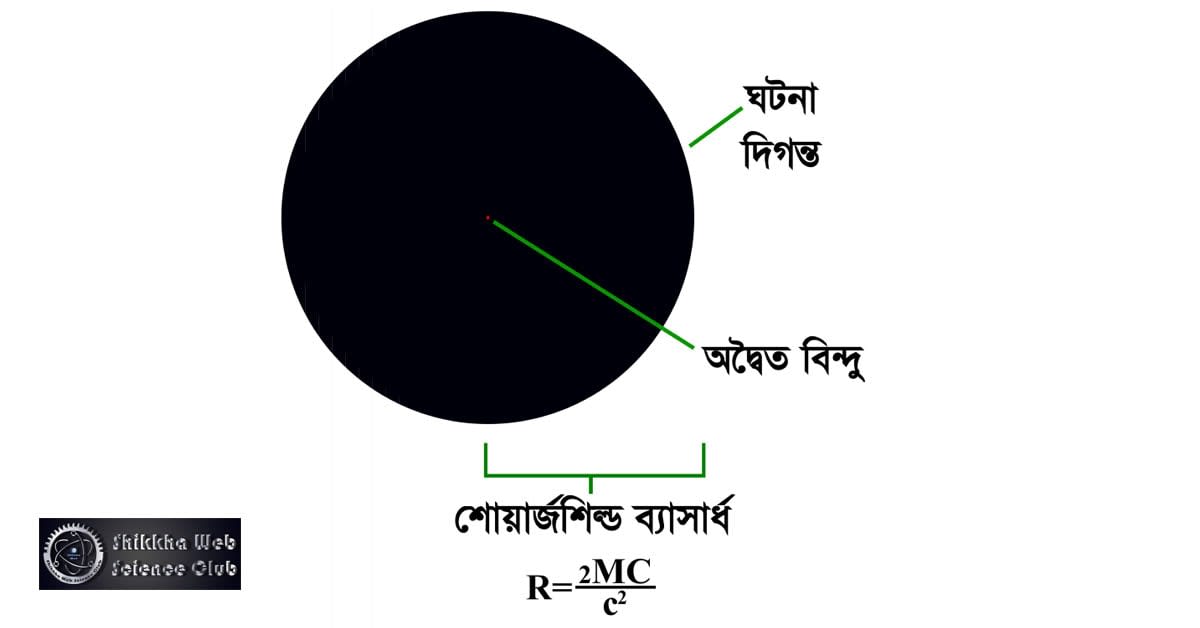
The word horizon in the name event horizon gives you a sense of the description too. The boundary of a black hole beyond which nothing can return is what is called the event horizon. It is called the ‘point of no return', because once this limit is crossed, a thing is lost into the pit of the black hole.
This event horizon is taken as the size of the black hole, because it is from here that the black hole's essential power begins.
The critical radius, or Schwarzschild radius
So — we have understood a good deal. Now, for something to become a black hole, what characteristics does it have to acquire?
In fact, to become a black hole an object of enormous mass has to be brought down to a tiny size by reducing its radius. Then anything at all can be turned into a black hole, because with such a vast amount packed into a tiny space its gravitational attraction becomes so intense that not even light can get out. So when an object's radius becomes equal to or smaller than a certain critical radius, it turns into a black hole. The equation for finding this critical radius is,
Rₛ = 2GM/c²
Put the object's mass M into this equation and you get the critical radius. If we work it out for the Earth, let me say at the start that the Earth's radius is 6,371,000 metres. Then the Earth's critical radius will be 0.0089 metres, or 0.89 centimetres! Which means that if we could squeeze this enormous Earth down to a radius of roughly 1 centimetre, the Earth would become a black hole 😉
Anyway, this remarkable equation was brought out of Einstein's general theory of relativity by the scientist Karl Schwarzschild. So it is also called the Schwarzschild radius, after his name.
Hawking radiation
Does nothing at all come out of a black hole? It was once thought that nothing comes out of a black hole. Later, though, it has come to be thought that something does come out. Since the scientist Stephen Hawking proposed this idea of theoretical radiation, it has been named Hawking radiation.
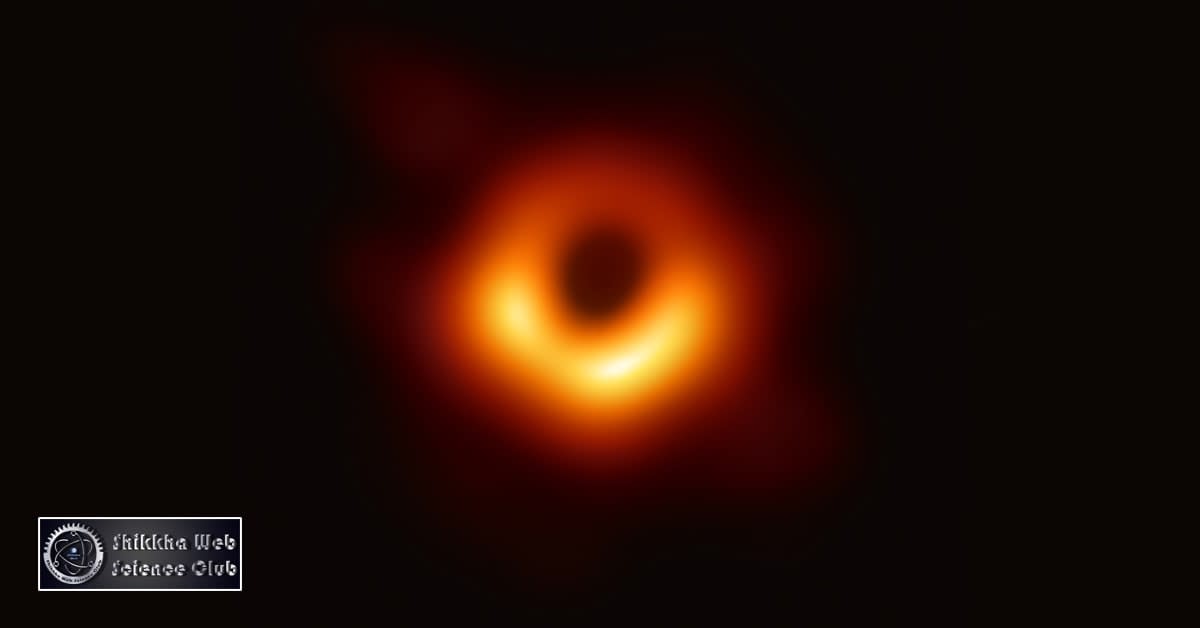
In 1974 Stephen Hawking showed how radiation like that of a black body occurs at a black hole. The simple explanation of the process is this: Hawking supposed that in the vacuum near a black hole's event horizon, particle-antiparticle pairs are created through fluctuations of energy. One of these falls into the black hole's event horizon while the other escapes before falling in, as Hawking radiation. As a result the black hole becomes visible, because particles are being emitted here.
Since the energy of the particle that escapes the event horizon is positive with respect to the outside universe, the energy of the particle that falls into the black hole will be negative with respect to the outside universe. As a result the black hole continually loses energy and mass — because mass and energy are only forms of one another (by the formula E=mc²).
It is thought that through this continual radiation a black hole will one day be extinguished. Many scientists disagree about Hawking radiation, though.
A journey into a black hole
That is enough waffle. Now let's take a tour of a black hole in the holiday the coronavirus has given us. 😜 No fear — you do not have to leave the house to travel into a black hole. Just put your imagination to work. So let's begin: mission black hole!
On reaching the event horizon, take a jump. The black hole will then invite you in. Remember falling objects? You surely read about them in a textbook. A falling object is weightless, and you will then feel weightless yourself. But there is nothing comforting in that. The real surprise starts a moment later.
Since your feet will be below your head, the pull on your feet will be far greater. At first you will become elongated. Gradually, the deeper you go, the pull will grow more and more intense, and you will keep stretching. Stretching and stretching, you will become as long as a noodle 😛. Or even before that, the pull may separate your legs from your body. In fact you will not have to reach the far end: before that you will be torn apart and turned into particles 😥.
So there is no need to travel here even by mistake. Now and then, in your imagination, you can lose yourself in the kingdom of black holes 😉.
Anyway, no more for today. I am ending these two short articles on black holes. A great many large parts of the subject could not be covered. And beyond that there is a great deal outside my own knowledge that it was not possible to tell.