





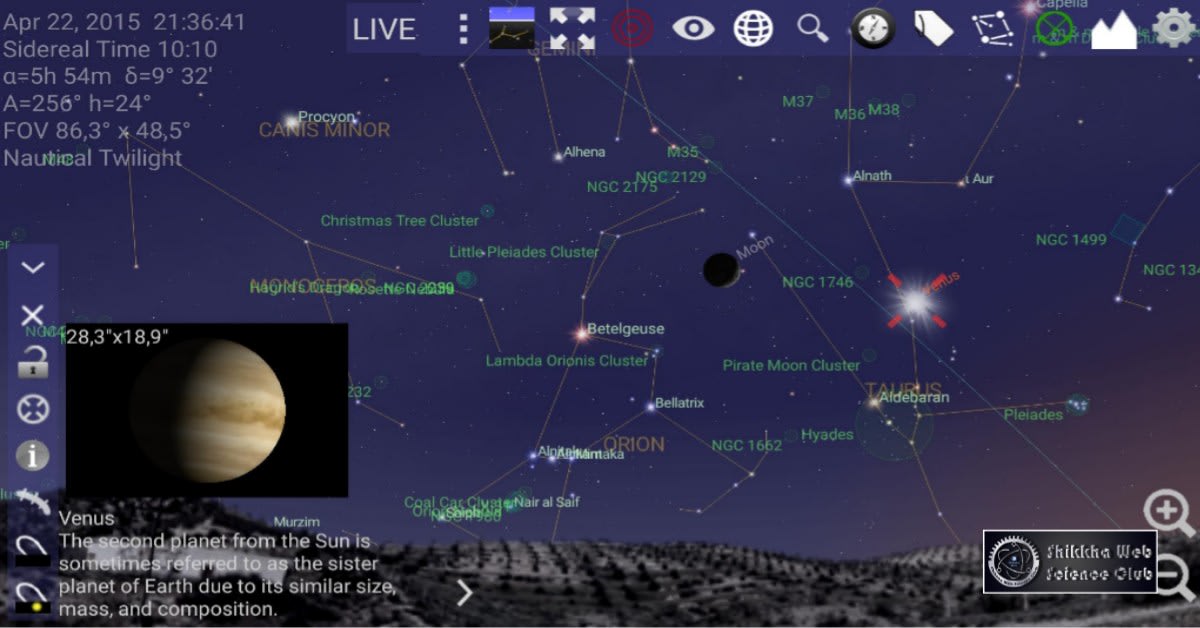
I have sat down to write an app review again after almost a year. I usually write reviews of science and education apps. In today's episode of the app review series I will introduce you to an astronomy app. For lovers of astronomy this is a wonderful app. Let's take a detailed look 😀
What makes it special
Many people would like to observe the sky and perhaps never get the chance, because it takes a lot of kit. With this app there is no such worry. You are bound to be surprised when you hear what it can do.
Suppose you have a wish to watch a lunar eclipse, or you want to see a comet. How would you get the news? No need to worry — this app will tell you. You can also find out when Jupiter will come into alignment with the Moon. Some of the main things you can learn:
* A live map of the sky * Detailed information on stars * Detailed information on planets * Various deep-sky objects * Meteor showers * Detailed information on asteroids * Solar eclipses * Lunar eclipses * Detailed information on comets * Remarkable views of the solar system And a great deal more.
Now let's go through all the features.
The features
– Zoomable sky map showing stars, planets, asteroids, and more (above and below the horizon) – Interactive top-down view of the Solar System – Live mode (point device on sky and get information on what you see) – Calendar showing detailed descriptions of celestial events – Push celestial events to your phone’s calendar and set a reminder alarm – Rise, set, and transit times for any object – Position of any object in the sky (altitude and direction) – Twilight times, length of day – Bright Star Catalog (~9000 stars) with detailed information – More than 400 000 additional stars from the PPM Star Catalog (Android 3.1 or higher required) – 2500 selected NGC objects (galaxies, clusters, …) – Messier Catalog (110 objects) complete with images – Caldwell Catalog (110 objects) complete with images – Hidden Treasures Catalog (109 objects) complete with images – Meteor streams (begin, maximum, hourly rate, …) – Lunar and solar eclipses information – Lunar librations, ascending node, maximum declination – Bright comets (automatically selected according to the date) – Dwarf planets: The five known dwarf planets – Minor planets: bright, near Earth, trans-Neptune (more than 10000 in the database) – Update database online: download up-to-date orbital elements of comets and minor planets – Moon phases, the apparent view of the sun and planets – Current image of the Sun and sunspot number – Automatically generated visibility report for any object – Simulation of light pollution – Intuitive User Interface: quickly find what you are looking for – Widget with rise & set times of the Sun and Moon – Maintain your favorite locations in a list – Automatic location determination from the mobile network or GPS – Select a location from a built-in database or online via Google Maps – 400 observatory locations – Choose any time and date – Detailed ephemeris, visibility information of all objects – Dates of conjunctions between any object with planets or the Moon – 3D-view of the Moon and the planets – Accurate calculations for dates between 1900 and 2100
App information
Name: Mobile Observatory 2 Rating: 4.8 Installs: 100,000+ Download link: https://play.google.com/store/apps/details?id=com.kreappdev.astroid